
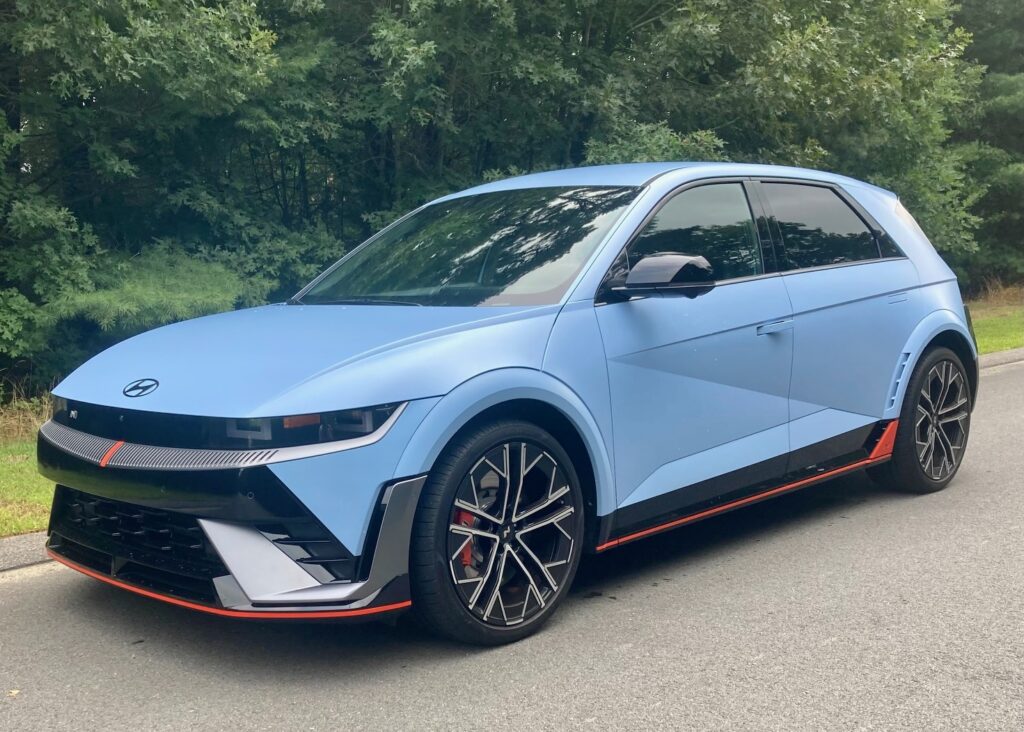
Picture this: You’re zipping along your favorite stretch of twisty two-lane in the latest hot hatchback, accompanied by the throaty sound of rising and falling RPM as you work your way through the gears with paddle shifters. The response is instantaneous, the acceleration phenomenal, and the sound intoxicating.
And it’s all fake. Or at least the sounds are. The performance is as real as a heart attack, taking you from 0-60 mph in less than 3.5 seconds. That’s because you’re driving the new Hyundai Ionic 5 N, an electric-powered car with two motors pumping out up to 641 horsepower driving all four wheels.
The sounds, the millisecond pause in acceleration between “gear” changes, and even the sweeping needle of the tachometer as revs increase have nothing to do with what’s actually going on under the hood. Or the trunk. Or wherever it’s coming from.
What’s even wilder is that the frenzied racket in the cockpit is completely contained within. Other motorists and pedestrians hear nothing but the hum of an electric car whooshing by. That’s part of what makes the Ionic 5 N so cool. You can be engaging in all kinds of antisocial driving behavior at 30 mph, and nobody is the wiser. At least they don’t notice that silly grin on your face.
Call it clever, call it a pointless gimmick, call it both. But no matter what you think of the technology, Hyundai has done a remarkably convincing job of developing it and using speakers to mimic the sounds and feel of a conventionally powered car.

You do, of course, have the option of foregoing the boy racer experience entirely. Without it, the Ionic 5 N performs and sounds pretty much like any other electric vehicle, if a somewhat quicker and sportier one than most. Opting for the N gets you far more than a canned audio experience, adding all sorts of other electronic wizardry for enhanced handling on and off the track. There’s even a drift feature for those who prefer to do their driving sideways.
Plus, the N version has all the baked-in goodness of less hyperactive Ionic 5 trims, including its spacious and comfortable cabin with plenty of room for five passengers and cargo, plenty of easy-to-use tech, and faster charging capability than many competitors. In Normal mode, it’s as benign as a base Ionic 5, if a faster one with fatter tires and highly bolstered seats.
But punch up the N’s enhanced capability, and it turns into a burbling, snarling, frenetic beast. And the transformation goes beyond a mere engine sound, adding a tachometer to the instrument display and the feel of an eight-speed dual-clutch transmission through those paddle shifters.
The sound may not be that of a throaty V8, or even much like a turbocharged four-banger. But it’s definitely engine-like, and enough so that in my completely unscientific evaluation it actually feels like you’re going faster in N mode than without it.
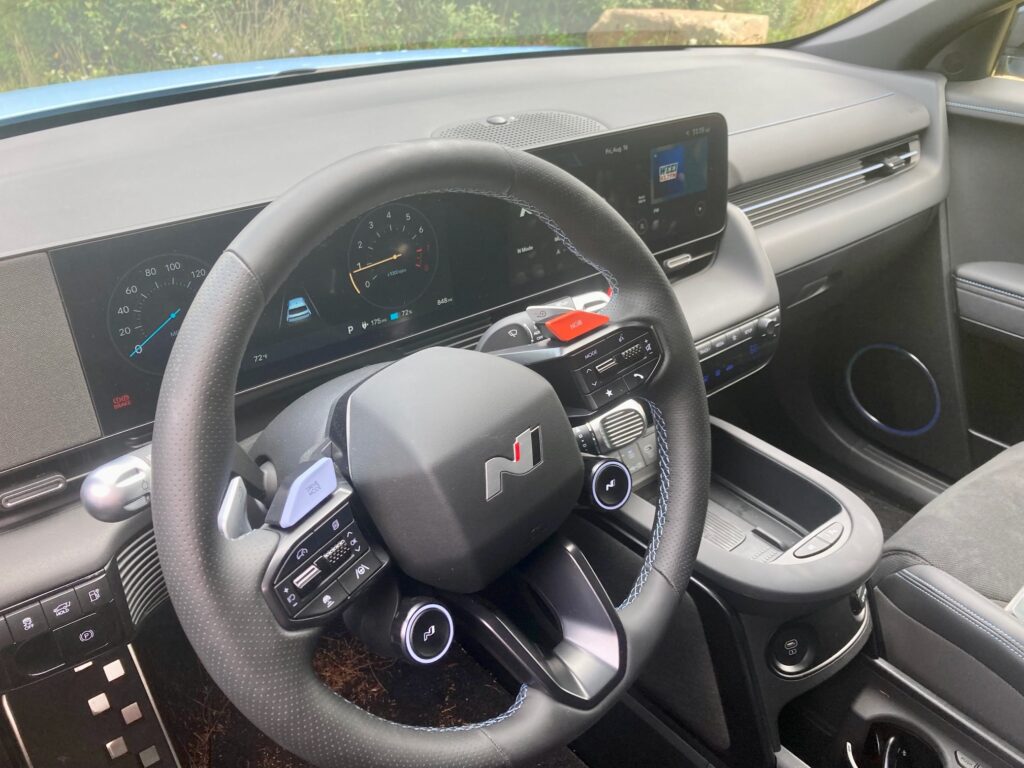
There will undoubtedly be some enthusiast drivers who are less than impressed with Hyundai’s efforts to make an EV sound like an internally combusted performance car. Chances are those folks aren’t in Hyundai’s target demographic for the 5 N anyway and aren’t going to be buying any EVs soon. To those drivers, let me offer a heartfelt get over yourself.
There will also be those who think Hyundai has crossed some kind of line by piping artificial engine sounds into the cabin. It’s worth pointing out here that lots of automakers have been pumping artificial soundtracks into cars for years, including some of those throaty-sounding muscle machines.
Conversely, most EV buyers could probably care less if they never again heard the rumble of a small block Chevy, and won’t see the point of the Ionic 5 N and its N button, either. That’s ok, too.
Me, I’m ok with the Ionic 5 N just as it is.
No comments yet.